Let \(R\colon\IR^2\to\IR^2\) be the transformation given by rotating vectors about the origin through and angle of \(45^\circ\text{,}\) and let \(S\colon\IR^2\to\IR^2\) denote the transformation that reflects vectors about the line \(x_1=x_2\text{.}\)
If \(L\) is a line, let \(R(L)\) denote the line obtained by applying \(R\) to it. Are there any lines \(L\) for which \(R(L)\) is parallel to \(L\text{?}\)
Consider the linear transformation \(A : \IR^2 \rightarrow \IR^2\) given by the matrix \(A = \left[\begin{array}{cc} 2 & 2 \\ 0 & 3 \end{array}\right]\text{.}\)
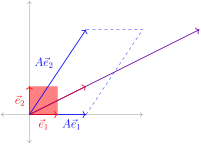
A figure in the \(xy\)-plane. A blue vector pointing right along the \(x\)-axis is labeled \(A\vec{e}_1\text{.}\) A blue vector pointing up and right is labeled \(A\vec{e}_2\text{.}\) Dotted blue lines complete the parallelogram spanned by these two vectors. A red horizontal vector labeled \(\vec{e}_1\) and a red vertical vector labeled \(\vec{e}_2\) form the edges of a red square. A red vector points up and to the right through the middle of the parallelogram, and a purple, longer vector parallel to this vector extends out further.
Figure59.Transformation of the unit square by the linear transformation \(A\)
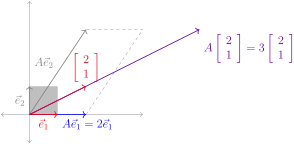
The image from Figure 59 is reproduced with most of the parts grayed out. The red vector pointing up and to the right is now labeled \(\left[\begin{array}{c}2 \\ 1 \end{array}\right]\text{,}\) and the purple parallel vector remains; it is labeled to the right with \(A\left[\begin{array}{c}2 \\ 1\end{array}\right]=3\left[\begin{array}{c}2 \\ 1\end{array}\right]\text{.}\) The red vector \(\vec{e}_1\) remains, and the parallel blue vector is now labeled \(A\vec{e}_1=2\vec{e}_1\text{.}\)
Figure60.The map \(A\) stretches out the eigenvector \(\left[\begin{array}{c}2 \\ 1 \end{array}\right]\) by a factor of \(3\) (the corresponding eigenvalue).
In other words, \(A\vec{x}=\lambda \vec{x}\) for some scalar \(\lambda\text{.}\) If \(\vec x\not=\vec 0\text{,}\) then we say \(\vec x\) is a nontrivial eigenvector and we call this \(\lambda\) an eigenvalue of \(A\text{.}\)
If \(\lambda\) is an eigenvalue, and \(T\) is the transformation with standard matrix \(A-\lambda I\text{,}\) which of these must contain a non-zero vector?
Let \(A\in M_{n,n}\) and \(\lambda\in\IR\text{.}\) The eigenvalues of \(A\) that correspond to \(\lambda\) are the vectors that get stretched by a factor of \(\lambda\text{.}\) Consider the following special cases for which we can make more geometric meaning.
What are the maximum and minimum number of eigenvalues associated with an \(n \times n\) matrix? Write small examples to convince yourself you are correct, and then prove this in generality.