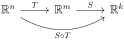
If \(T: \IR^n \rightarrow \IR^m\) and \(S: \IR^m \rightarrow \IR^k\) are linear maps, then the composition map \(S\circ T\) computed as \((S \circ T)(\vec{v})=S(T(\vec{v}))\) is a linear map from \(\IR^n \rightarrow \IR^k\text{.}\)
A representation of the composition of maps. The chain \(\IR^n \rightarrow \IR^m \rightarrow \IR^k\) is adorned with a \(T\) labeling the arrow from \(\IR^n\) to \(\IR^m\text{,}\) and a \(S\) labeling the arrow from \(\IR^m \rightarrow \IR^k\text{.}\) Below this is a curved arrow connecting \(\IR^n\) on the left to \(\IR^k\) on the right, which is labeled \(S \circ T\text{.}\)
Let \(T: \IR^3 \rightarrow \IR^2\) be defined by the \(2\times 3\) standard matrix \(B\) and \(S: \IR^2 \rightarrow \IR^4\) be defined by the \(4\times 2\) standard matrix \(A\text{:}\)
We define the product \(AB\) of a \(m \times n\) matrix \(A\) and a \(n \times k\) matrix \(B\) to be the \(m \times k\) standard matrix of the composition map of the two corresponding linear functions.
For the previous activity, \(T\) was a map \(\IR^3 \rightarrow \IR^2\text{,}\) and \(S\) was a map \(\IR^2 \rightarrow \IR^4\text{,}\) so \(S \circ T\) gave a map \(\IR^3 \rightarrow \IR^4\) with a \(4\times 3\) standard matrix:
Let \(S: \IR^3 \rightarrow \IR^2\) be given by the matrix \(A=\left[\begin{array}{ccc} -4 & -2 & 3 \\ 0 & 1 & 1 \end{array}\right]\) and \(T: \IR^2 \rightarrow \IR^3\) be given by the matrix \(B=\left[\begin{array}{cc} 2 & 3 \\ 1 & -1 \\ 0 & -1 \end{array}\right]\text{.}\)
\begin{equation*}
A = \left[\begin{array}{ccc}1&0&-3\\3&2&1\end{array}\right]
\hspace{2em}
B = \left[\begin{array}{ccccc}2&2&1&0&1\\1&1&1&-1&0\\0&0&3&2&1\\-1&5&7&2&1\end{array}\right]
\hspace{2em}
C = \left[\begin{array}{cc}2&2\\0&-1\\3&1\\4&0\end{array}\right]
\end{equation*}
(a)
Find the domain and codomain of each of the three linear maps corresponding to \(A\text{,}\)\(B\text{,}\) and \(C\text{.}\)
Let \(T\left(\left[\begin{array}{c}x\\y \end{array}\right]\right)=
\left[\begin{array}{c} x+2y \\ y \\ 3x +5y \\ -x-2y \end{array}\right]\) In Fact 3.2.12 we adopted the notation
Given two \(n\times n\) matrices \(A\) and \(B\text{,}\) explain why the sentence "Multiply the matrices \(A\) and \(B \) together." is ambiguous. How could you re-write the sentence in order to eliminate the ambiguity?
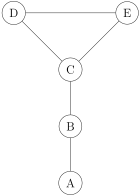
An adjacency matrix for this map is a matrix that has the number of roads from city \(i\) to city \(j\) in the \((i,j)\) entry of the matrix. A road is a path of length exactly 1. All \((i,i)\)entries are 0. Write the adjacency matrix for this map, with the cities in alphabetical order.